0%

Choosing a 6-Passenger Electric Shuttle Cart is not just a matter of picking the newest model or the longest feature list. The right cart should fit its daily route, passenger needs, and charging routine. A hotel may need quiet rides across paved paths, while a large property may face gentle slopes and frequent stops. Those details change what matters.

Start by checking the rated passenger capacity, load limit, range, and braking system. Six seats do not tell the whole story. Luggage, accessibility needs, and uneven ground can affect comfort and performance. Ask how range was measured, since real results can vary with terrain, temperature, passenger weight, and driving style. Then compare battery type, charging time, service access, and warranty terms. Small details count.

A clear evaluation also looks at seat belts, lighting, mirrors, weather protection, and turning space. These features shape everyday use, not just the showroom impression. If possible, arrange a test drive with a realistic passenger load. Listen for unusual motor noise and notice how smoothly the cart starts, stops, and turns. Specifications help, but they can leave gaps. A careful buyer should verify key claims with the manufacturer or dealer and consider who will maintain the vehicle after purchase. The best choice is the one that reliably serves its route, fits the budget over time, and feels practical to operate—not simply the one with the most impressive brochure.
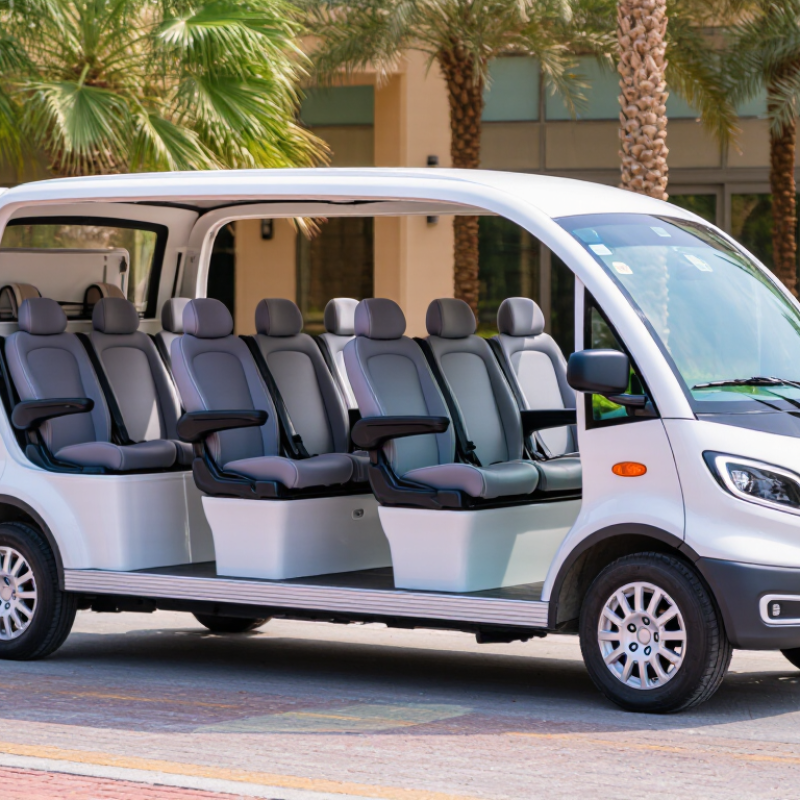
How to Choose the Best 6 Passenger Electric Shuttle Cart?

Define the Use Case: Six Seats, Payload, and the 25 mph LSV Limit

Start with the route, not the seat count. Will the cart carry guests across a resort, move staff around a campus, or travel on public roads? NHTSA’s Federal Motor Vehicle Safety Standard No. 500 defines a U.S. low-speed vehicle as one capable of more than 20 mph, but no more than 25 mph, with a gross vehicle weight rating below 3,000 pounds. It also specifies required safety equipment. The 25 mph figure is a classification ceiling, not a recommended speed for every route. Check slopes, tight turns, frequent stops, and crossing points. Measure the whole trip.

Six seats do not guarantee useful passenger space or enough carrying capacity. For a planning example, six riders weighing 180 pounds each add 1,080 pounds before bags, tools, or accessories. Compare the expected total with the cart’s rated payload, and check its GVWR separately; those figures are not interchangeable. I would not assume every “six-passenger” layout fits six adults comfortably. Knee room, entry space, and rear-seat access matter, especially when riders carry luggage. A small detail, easily missed. Ask for the payload rating and seating dimensions in writing, then match them to a typical trip rather than an ideal one.

Check Legal Fit: U.S. LSVs Have a GVWR Below 3,000 lb

A six-passenger electric shuttle may look road-ready, but seating capacity does not determine its legal classification. In the United States, a low-speed vehicle generally must have a gross vehicle weight rating below 3,000 pounds and meet federal speed and equipment requirements. The exact rating matters. Check the manufacturer’s certification label and documentation, rather than relying on a sales listing or the cart’s empty weight.

GVWR is the maximum permitted loaded weight, not the vehicle’s weight before passengers climb aboard. Compare it with the curb weight to estimate the available payload. Then account for six occupants, bags, added accessories, and any installed equipment. A full row of adults can change the calculation quickly. That detail is easy to miss. A cart may have six seats yet leave little room for cargo while staying within its rating.

Before choosing a model, ask for its rated payload and confirm how it is classified and equipped. Federal LSV status also involves requirements beyond weight, while state and local rules can affect where the vehicle may operate. Verify those details with the seller and relevant local authorities before purchase. I would not treat a low GVWR as proof of road legality; paperwork and equipment matter too.

Compare Battery Capacity: 48 V × 100 Ah Equals 4.8 kWh Nominal

How to Choose the Best 6 Passenger Electric Shuttle Cart?

Compare Battery Capacity: 48 V × 100 Ah Equals 4.8 kWh Nominal

A 48 V battery rated at 100 Ah stores 4,800 Wh, or 4.8 kWh nominal. This figure is a useful starting point when comparing six-passenger shuttle carts. It describes stored energy, not the exact amount available for driving. Battery chemistry, discharge limits, temperature, and age can all affect usable capacity. The arithmetic is tidy; real operation is less so.

Tips: Check the battery specifications for usable capacity, not just nominal energy. Estimate your daily route, then consider passenger weight, hills, stops, and lights. A short test run with a realistic load can reveal more than a brochure estimate.

Think about where the cart will work. A flat, slow route with frequent charging may suit a smaller usable-energy reserve. Longer routes, steep ramps, or repeated trips need more margin. Ask how the cart performs near the end of a shift, when capacity is lower. Do not choose by kWh alone; compare charging time and expected duty cycle, too. I would leave room for uncertainty rather than plan around a perfect range estimate.

How to Choose the Best 6-Passenger Electric Shuttle Cart?

Compare battery capacity: nominal energy (kWh) = voltage (V) × capacity (Ah) ÷ 1,000.

At 48 V, a 100 Ah battery provides 4.8 kWh of nominal energy. These values are calculations, not estimates of usable energy or vehicle range; actual performance depends on battery chemistry, operating conditions, and power consumption.

Estimate Range: Usable kWh ÷ Energy Use per Mile

How to Choose the Best 6 Passenger Electric Shuttle Cart?

Estimate range with a simple calculation: usable battery energy in kWh divided by measured energy use per mile. If a cart has 10 usable kWh and consumes 0.25 kWh per mile, its estimated range is 40 miles. That is a planning figure, not a guarantee. Use usable capacity, not the battery’s advertised total; some energy may be held back by the battery management system. Small details matter.

The U.S. Department of Energy’s Alternative Fuels Data Center reports that electric vehicles convert about 87–91% of stored energy into motion, including energy recovered through regenerative braking. That broad figure does not predict a shuttle cart’s range. Passenger load, hills, stop-and-go driving, tire pressure, and weather change consumption. Test the six-passenger cart on a route resembling daily service, then calculate kWh per mile from the energy used. A neat number from a flat test track can mislead.

Tips: Record battery energy before and after a full route, along with distance, passenger count, and weather. Repeat the test. For a working estimate, divide usable kWh by the higher of several measured consumption results, then keep a reserve for detours or aging batteries. Real routes are messy. A little margin is sensible.

Assess Safety and Ownership Costs: Restraints, Brakes, Warranty, and Charging

A six-passenger shuttle carries more than people; it carries changing loads, bags, and expectations. Check every seat’s restraint for secure anchoring, smooth operation, and a buckle that clicks firmly. Ask whether all seating positions have appropriate belts. Small details matter. A twisted strap or hard-to-reach buckle may go unnoticed during a quick showroom check.

Brakes deserve attention with the cart carrying a realistic passenger load. Ask how often pads, cables, or hydraulic components need inspection, and whether replacement parts are readily available. A controlled test drive can reveal pulling, unusual noises, or a pedal that feels inconsistent. Don’t judge stopping performance on an empty cart alone. That shortcut is tempting, but it can give a misleading impression.

Compare warranty coverage for the battery, charger, motor, and labor. Read exclusions and service requirements carefully; a long warranty may cover less than expected. For charging, confirm the outlet and charger suit the cart’s battery system, then check charging time and any ventilation or temperature guidance in the manual. Ask about battery replacement costs, too. I would not choose on purchase price alone: daily charging access and downtime can quietly change the ownership calculation. Some costs are harder to predict than others.

FAQS

What should I check before choosing a six-seat electric shuttle?

Start with the route, not the seat count. Note hills, tight turns, frequent stops, and crossing points. A resort loop differs from a campus route.

Do six seats mean six adults will fit comfortably?

Not always. Check knee room, entry space, and rear-seat access. Try loading six adults with their bags. Small details matter.

How much weight can six passengers add?

Six riders weighing 180 pounds each add 1,080 pounds before bags or equipment. Compare the expected load with the rated payload. I might overlook luggage in a quick estimate.

What is the difference between payload and GVWR?

Payload is the rated carrying capacity for occupants and cargo. GVWR is the maximum permitted loaded vehicle weight. Keep them separate.

How can I estimate driving range?

Divide usable battery energy in kWh by measured energy use per mile. For example, 10 usable kWh divided by 0.25 kWh per mile gives about 40 miles. Not a guarantee.

Why can real-world range be lower?

Hills, frequent stops, passenger load, tire pressure, and weather can increase energy use. A flat test route can mislead.

How should I test range for daily service?

Record battery energy and distance before and after a typical route. Note passenger count and weather, then repeat the test. Real routes are messy.

What should I verify before public-road use?

Check the vehicle’s classification, required safety equipment, and local operating requirements. Confirm details using its documentation and relevant local authorities. A speed rating alone is not enough.

Conclusion

Choosing the right 6-Passenger Electric Shuttle Cart starts with how and where it will be used. Consider whether six seats provide enough room for passengers and cargo without exceeding the cart’s payload rating, and whether its speed suits the intended routes. If the vehicle will be used on U.S. roads as a low-speed vehicle, check applicable requirements, including the general 25 mph speed limit and a gross vehicle weight rating below 3,000 pounds.

Next, compare battery capacity and estimate practical range rather than relying on a headline figure. A 48-volt, 100-amp-hour battery has a nominal capacity of 4.8 kWh; estimated range can be calculated by dividing usable battery energy by energy use per mile. Finally, review passenger restraints, braking equipment, warranty coverage, and charging time. Together, these checks help match the cart to its daily workload, expected travel distance, and total cost of ownership.

Ethan

Ethan

Ethan is a professional marketing specialist dedicated to helping customers understand practical solutions, product value, and emerging trends in the industry. With extensive knowledge of the company’s products and a strong understanding of customer needs, he creates clear, informative, and useful......