Choosing the right Resort Electric Shuttle Vehicle is no longer a simple matter of comparing passenger capacity and paint colors. Global buyers now examine battery chemistry, charging access, hill performance, weather protection, and long-term service support. A quiet six-seat shuttle may appear ideal on a brochure, yet struggle on steep resort roads or during continuous hotel transfers.
The International Energy Agency reported in its Global EV Outlook 2024 that electric car sales exceeded 14 million units worldwide in 2023, representing about 18% of global car sales. Although resort shuttles serve a narrower market, this growth signals stronger battery supply, broader charging investment, and improving buyer confidence. BloombergNEF’s Electric Vehicle Outlook 2024 also highlights falling battery costs and expanding electrification across commercial transport. The direction is encouraging. It is not effortless.
Colin McKerracher, Head of Advanced Transport at BloombergNEF, has stated, “The transition to electric transport is a system change, not simply a vehicle purchase.” That principle matters inside resorts. Route length, passenger peaks, charging windows, terrain, and maintenance skills must be assessed together. A vehicle with a 100-kilometre claimed range may deliver less under heavy loads, cold weather, or repeated climbs. Real testing matters.
This guide reviews seven leading Resort Electric Shuttle Vehicle options for international buyers. It considers usable range, seating layouts, charging practicality, safety equipment, accessibility, durability, and after-sales support. Some models offer excellent comfort but limited customization. Others seem less polished, yet provide stronger fleet economics. The “best” choice depends on the resort’s daily reality. Geological conditions, local standards, and operating habits can change the answer.
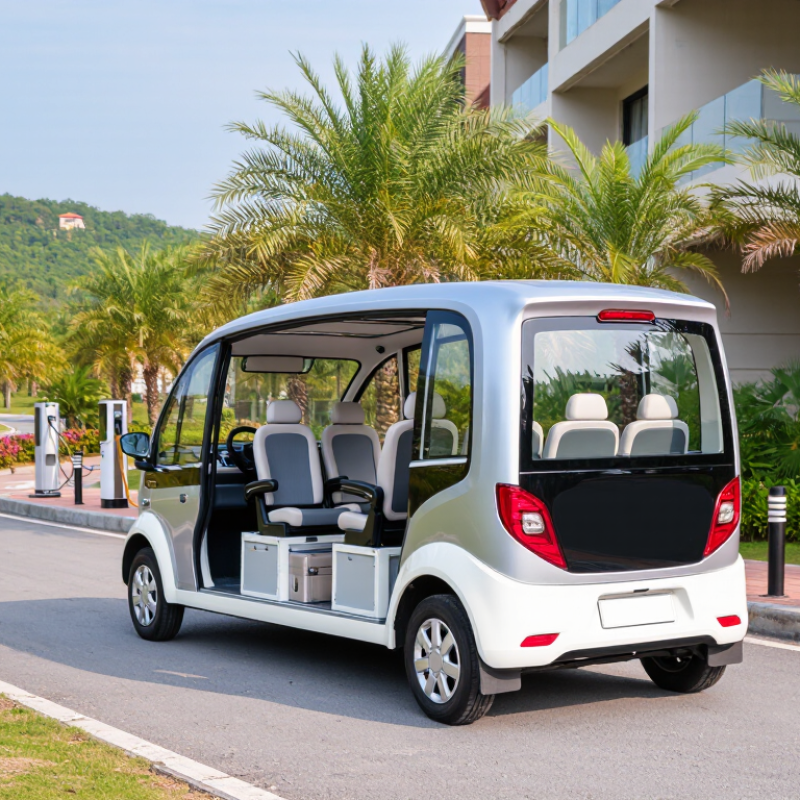
Resort electric shuttle vehicles are compact passenger carriers designed for hotels, parks, campuses, and destination properties. They connect parking areas, villas, lobbies, restaurants, and activity zones. Most use a rechargeable battery, electric motor, onboard charger, and regenerative braking system. The vehicle is simple. The operating plan is not.
During service, the battery sends power to the motor through an electronic controller. When the driver releases the accelerator, regenerative braking can return some energy to the battery. Charging usually happens overnight or during scheduled breaks. The U.S. Department of Energy’s Alternative Fuels Data Center notes that charging time depends on battery size, charger output, and remaining charge. A full load, steep paths, air conditioning, and frequent stops can reduce practical range. Range is not fixed.
The International Energy Agency reported over 14 million electric cars sold globally in 2023, representing about 18% of new car sales. Shuttle vehicles follow different duty cycles, so passenger-car statistics cannot predict resort performance exactly. Operators should record route length, passenger weight, gradients, weather, and daily charging time before choosing capacity. A quiet motor improves guest comfort, but it can also make pedestrians less aware. That detail deserves attention. Field trials often reveal problems that specification sheets miss, including slow charging access, slippery surfaces, or insufficient luggage space. Our view is cautious: electric operation can reduce local noise and energy use, but only when the route design matches the vehicle’s real workload.
Choosing the seven best resort electric shuttle vehicles requires more than comparing passenger capacity. Start with route reality: steep paths, salt air, tight turning areas, and repeated hotel-to-beach trips. Measure usable battery capacity, not only the advertised range. The International Energy Agency’s Global EV Outlook 2024 reported strong growth in electric bus deployment, but operating conditions still change real-world range significantly.
For global buyers, examine motor torque, gradeability, and regenerative braking performance. A shuttle carrying fourteen passengers needs stable acceleration on wet slopes. Battery chemistry, thermal management, and charging speed also deserve close attention. BloombergNEF reported that average lithium-ion battery prices fell to 115 US dollars per kilowatt-hour in 2024. Lower pack costs help, but replacement access and warranty coverage remain critical. Ask for cycle-life data under high-temperature operation.
Comfort affects guest experience. Check step height, turning radius, suspension travel, cabin ventilation, and wheelchair access. A quiet vehicle is valuable near villas and spa areas. Charging infrastructure must match fleet scheduling. The IEA noted continued global expansion of public charging points in 2023, yet remote resorts may still face weak grids or long installation lead times. In my experience, buyers often overestimate range and underestimate charging downtime. That mistake is expensive. Compare maintenance intervals, diagnostic support, spare-part availability, and local technician training. A polished brochure cannot replace a supervised hill test with a full passenger load.
Seven leading resort electric shuttle vehicles for global buyers should match route length, passenger flow, and local weather. The strongest choices include a four-seat open shuttle, six-seat guest carrier, eight-seat family shuttle, accessible low-floor vehicle, enclosed all-weather shuttle, luggage shuttle, and staff utility vehicle. Each option serves a different resort routine. A compact four-seat model fits narrow garden paths. An accessible vehicle needs a stable ramp, clear turning space, and secure wheelchair restraint points.
The International Energy Agency reported that global electric car sales exceeded 17 million in 2024. That growth supports wider charging investment, but resort vehicles face different demands. They stop frequently, climb slopes, and often operate for ten hours daily.
The U.S. Department of Energy advises checking battery capacity, charging access, and duty cycles before fleet selection. In practice, regenerative braking can help on hilly routes. However, cold weather may reduce usable range. A quiet vehicle can improve guest comfort. It may also create pedestrian-safety concerns if visitors do not hear it approaching. That detail deserves more attention.
Tips: Measure the longest route at full passenger load. Keep a charging reserve of at least 15 percent. Confirm ramp dimensions, turning radius, corrosion protection, and replacement-part availability. Ask for tested range, not promotional range. The Global EV Outlook offers useful market context, but it does not replace a route trial. A one-day demonstration may reveal uncomfortable seats, weak hill performance, or poor luggage access. That is where many buying decisions become less certain.
Resort mobility starts with the route, not the vehicle. UN Tourism reported about 1.4 billion international arrivals in 2024. That pressure makes efficient internal transport more important. The seven most useful formats serve different resort conditions. Four-seat vehicles suit villas and short guest transfers. Six-seat models handle families with light luggage. Eight- to fourteen-seat shuttles work better between parking areas, lobbies, and beaches. Enclosed vehicles protect guests during rain, wind, or intense sunlight. Low-floor models with ramps support accessible travel. Utility shuttles move linen, tools, and supplies. Extended-range vehicles fit large properties with fewer charging points.
The International Energy Agency’s Global EV Outlook 2024 recorded nearly 14 million electric car sales in 2023. Electric technology is becoming more practical, but resort duty cycles remain unusual. Repeated starts, slopes, full passenger loads, and air-conditioning can reduce range. A six-seat vehicle may look efficient, yet luggage can quickly change its capacity. That is an easy mistake. Charging access also matters more than brochure range. Measure daily kilometers, peak-hour demand, grade changes, and overnight parking before selecting a configuration.
Tips: Match vehicle size to the busiest 30-minute period, not average traffic. Keep one accessible unit available on every major route. Test turning radius near pool decks and service gates. Review battery performance after rain, heat, and frequent stops. IEA data supports electrification, but local operating evidence should guide the final purchase.
Global resort buyers should evaluate electric shuttle vehicles beyond purchase price. The International Energy Agency reported nearly 14 million electric cars sold worldwide in 2023, showing stronger charging experience and supplier maturity. However, resort shuttles face different demands. A vehicle carrying guests uphill, beside wet paths, needs predictable torque and reliable braking.
Safety starts with route design. Check battery protection, emergency isolation, seat-belt availability, lighting, mirrors, and pedestrian warning systems. ISO 3691-4 provides useful guidance for automated vehicle hazards, although resorts must confirm local requirements. The U.S. Department of Energy recommends matching charging equipment with vehicle voltage, duty cycle, and site capacity. A small parking area can become a bottleneck during breakfast hours. Do not trust brochure range alone.
Ownership costs deserve careful testing. The IEA notes that electric drivetrains generally use less energy than combustion systems, but electricity prices and battery replacement remain highly location-dependent. Request a loaded hill trial with air conditioning, repeated stops, and uneven surfaces. Measure energy use per route, not per laboratory cycle. This is where many purchasing plans become optimistic. Ask for service response times, spare-part availability, battery warranty limits, and software support across borders. A simple inspection log, recording tire wear, charging time, and brake performance, often reveals more than a polished sales presentation.
| Vehicle Type | Typical Passenger Capacity | Typical Operating Range | Maximum Speed | Battery and Charging | Approximate Vehicle Size | Best Resort Application | Key Safety Requirements | Indicative Purchase Price | Global Purchasing and Ownership Considerations |
|---|---|---|---|---|---|---|---|---|---|
| Compact 4-Seat Electric Cart | 4 passengers | 50–80 km per charge under light resort use | 20–30 km/h | 48 V lead-acid or lithium-ion battery; approximately 6–10 hours with a standard charger | About 2.4–3.0 m long and 1.2–1.3 m wide | Guest movement, housekeeping, security patrols, and short internal transfers | Seat belts, hydraulic or regenerative braking, parking brake, headlights, reflectors, horn, and speed control | Approximately US$6,000–US$15,000 | Lowest operating complexity and easy maneuverability. Confirm local rules for road access, charger plug type, battery recycling, and replacement-part availability. |
| 6-Seat Extended Electric Shuttle | 6 passengers | 50–90 km per charge | 20–32 km/h | 48 V or 72 V lithium-ion or lead-acid battery; approximately 6–10 hours | About 3.1–3.7 m long and 1.2–1.3 m wide | Medium-sized properties, villa zones, parking-to-lobby routes, and airport-style resort transfers | Three-point belts where fitted, stable suspension, non-slip flooring, clear passenger handholds, and a defined loading procedure | Approximately US$9,000–US$20,000 | Provides more seats without requiring a large vehicle. Check turning radius, rear overhang, tire availability, and whether passengers may legally be carried on public roads. |
| 8-Seat Heavy-Duty Shuttle | 8 passengers | 45–80 km per charge with full passenger load | 20–30 km/h | 48 V or 72 V battery system; approximately 7–12 hours depending on battery capacity | About 3.5–4.2 m long and 1.3–1.5 m wide | High-volume guest routes, conference areas, sports facilities, and large parking compounds | Load-rated brakes and suspension, roof protection, passenger restraints, emergency stop procedure, and driver training for slopes | Approximately US$14,000–US$28,000 | A practical balance between capacity and operating cost. Select lithium-ion for frequent use and lower routine maintenance, or lead-acid where acquisition cost is the priority. |
| 11-Seat Covered Electric Shuttle | 10–11 passengers | 40–75 km per charge under normal passenger service | 20–30 km/h | 72 V lithium-ion or lead-acid battery; approximately 8–12 hours | About 4.0–4.8 m long and 1.4–1.6 m wide | Hotels, integrated resorts, theme parks, golf communities, and longer internal routes | Weather-resistant roof, adequate ventilation, grab rails, door or side protection, reverse alarm, lights, and clearly marked passenger limits | Approximately US$22,000–US$40,000 | Covered seating improves comfort in hot or rainy climates. Verify corrosion protection, drainage, air circulation, and local vehicle classification before importation. |
| 14-Seat Long-Route Electric Shuttle | 12–14 passengers | 35–70 km per charge, depending on terrain and load | 25–40 km/h where legally permitted | 72 V or higher-capacity lithium-ion battery; approximately 8–14 hours | About 5.0–6.2 m long and 1.5–1.8 m wide | Large resorts, remote accommodation zones, staff transport, and scheduled loop services | Commercial-grade braking, high-visibility lighting, passenger doors or barriers, durable handrails, fire protection, and route-specific speed limits | Approximately US$35,000–US$70,000 | Requires wider lanes, larger turning areas, and stronger charging infrastructure. Analyze passenger demand, gradient, daily mileage, and local registration requirements before purchase. |
| 18-Seat Multi-Row Electric Bus | 16–18 passengers | 30–60 km per charge under heavy-load operation | 25–40 km/h where legally permitted | High-capacity lithium-ion battery; approximately 8–16 hours with depot charging | About 5.5–7.0 m long and 1.7–2.0 m wide | High-occupancy resorts, convention centers, destination parks, and fixed-route guest transportation | Commercial braking system, emergency exits, fire extinguisher, passenger restraints where required, wheelchair policy, and trained commercial drivers | Approximately US$60,000–US$120,000 | Best for concentrated passenger demand but has the highest infrastructure and maintenance requirements. Confirm axle load, turning clearance, homologation, insurance, and after-sales support. |
| Accessible Electric Shuttle with Wheelchair Ramp | 4–8 seated passengers plus 1 wheelchair, depending on layout | 40–80 km per charge | 20–30 km/h | 48 V or 72 V lithium-ion or lead-acid battery; approximately 6–12 hours | About 3.5–5.5 m long and 1.3–1.7 m wide | Universal guest service, accessible rooms, medical facilities, airports, and resorts serving elderly or mobility-impaired guests | Certified wheelchair restraint, non-slip ramp, adequate ramp angle, handrails, accessible boarding space, seat belts, and trained operators | Approximately US$18,000–US$55,000 | Confirm compliance with the destination’s accessibility and transport regulations. Measure door widths, ramp storage space, pavement gradients, and wheelchair dimensions before ordering. |
| Purchasing note: Specifications and prices are representative international market ranges for new electric resort shuttles and can vary by battery chemistry, passenger configuration, climate, terrain, import duties, certification, shipping, and local taxes. Confirm the tested range with the intended passenger load and route gradient. Before placing an order, request technical drawings, battery and charger certifications, warranty terms, spare-parts lists, service training, and documentation required for local registration. | |||||||||
They carry guests between parking areas, villas, lobbies, restaurants, and activity zones. They suit hotels, parks, campuses, and large destination properties. Short routes are common. Some models also move linen, tools, and supplies.
A rechargeable battery sends power to an electric motor. An electronic controller manages that power. Regenerative braking can return some energy during deceleration. Charging usually occurs overnight or during planned breaks.
There is no fixed answer. Full passenger loads, steep paths, air conditioning, and frequent stops reduce practical range. Battery size and charger output also matter. Measure real routes instead of trusting brochure figures alone.
Match capacity to the busiest 30-minute period. Four-seat vehicles suit villas and short transfers. Six-seat vehicles handle families with light luggage. Larger shuttles fit parking, lobby, beach, and activity routes.
Yes. A six-seat vehicle may carry fewer people with large bags. Luggage can block seats and narrow boarding space. This is an easy mistake. Check bags during field testing.
Enclosed vehicles protect passengers from rain, wind, and strong sunlight. They may improve comfort on exposed routes. However, added weight can affect energy use. Test them during hot and wet conditions.
Keep at least one accessible unit on every major route. Low-floor designs and ramps can support easier boarding. Check turning space near pool decks, gates, and narrow paths. Practical testing matters more than photographs.
Record route length, passenger weight, gradients, weather, and daily charging time. Test turning radius near service gates. Review battery performance after rain, heat, and frequent stops. Specification sheets miss some problems.
Quiet motors may make pedestrians less aware of approaching vehicles. Drivers should use careful speeds near walking areas. Clear route design also helps. The quietness is comfortable, but not always harmless.
Charging access may matter more than advertised range. Check overnight parking and scheduled break locations. A vehicle can have good range but poor charging access. That mismatch needs reconsideration.
Resort Electric Shuttle Vehicle solutions provide quiet, efficient, and environmentally responsible transportation for hotels, theme parks, golf communities, airports, and large hospitality properties. These vehicles typically use rechargeable battery systems, electric motors, regenerative braking, and flexible seating layouts to move guests and staff safely across short and medium-distance routes. When comparing options, global buyers should evaluate passenger capacity, driving range, charging time, ground clearance, turning radius, weather protection, accessibility features, operating speed, and maintenance requirements.
Different resort environments may require open-air shuttles, enclosed vehicles, luggage-friendly models, or compact units for narrow pathways. Successful purchasing also depends on route planning, climate suitability, charging infrastructure, spare-parts availability, operator training, warranty support, and compliance with local transportation and safety requirements. By balancing performance, comfort, total ownership cost, and after-sales service, resorts can select electric shuttle vehicles that improve guest experiences while supporting reliable and sustainable daily operations.